
Article 7: Why CMMC 2.0 Is Becoming a Competitive Differentiator, Not a Compliance Burden
Series: Understanding the Business Impact of CMMC 2.0 (2025–2026)
The Cybersecurity Maturity Model Certification (CMMC) 2.0 framework is frequently discussed in terms of implementation burden: cost, disruption, and organizational effort. While those considerations are real, they do not fully capture the broader business implications now taking shape across the defense industrial base.
CMMC 2.0 is increasingly influencing competitive positioning. More specifically, it is beginning to function as a threshold condition that determines whether an organization can participate in certain opportunities at all.
As certification requirements appear with greater regularity in solicitations, task orders, and contract modifications, the pool of eligible participants becomes more constrained. Organizations that can demonstrate the required certification level gain access to work that others are simply unable to pursue. In this context, compliance is no longer a secondary or administrative requirement; it is a condition of entry. Where certification must be in place at the time of award, eligibility effectively becomes a binary determination.
This shift has measurable effects on competitive behavior. Organizations that pursue certification early are not just reducing risk; they are expanding their strategic options. Early readiness allows them to engage with a wider set of opportunities, respond more decisively to emerging requirements, and avoid last-minute remediation pressures. By contrast, organizations that delay investment may conserve resources initially, but often face compressed timelines, limited assessor availability, and a progressively narrower set of viable pursuits.
The impact extends beyond individual firms to the structure of partnerships. Prime contractors are placing greater emphasis on the certification posture of their subcontractors and vendors when forming teams. Organizations that can demonstrate alignment with CMMC requirements reduce perceived execution risk and strengthen their position in teaming discussions. Those that cannot demonstrate readiness introduce uncertainty that primes may choose to avoid, particularly in environments where compliance obligations are tightly coupled to contract performance.
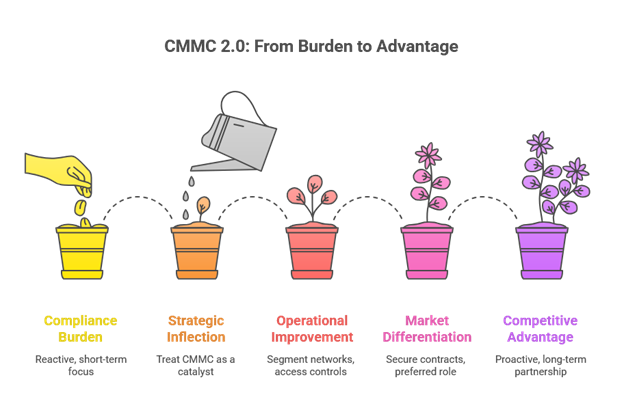
Figure: Treating CMMC as a strategic capability enables access and flexibility in competitive environments.
CMMC requirements are now being incorporated into active Department of Defense solicitations, with specific certification levels identified as prerequisites for award. In these scenarios, organizations that cannot demonstrate the required level are excluded from consideration, independent of their technical qualifications or prior performance history.
At the same time, emerging analysis suggests that adoption across the defense industrial base is unlikely to be uniform. Cost considerations, implementation complexity, and the availability of qualified assessors continue to influence how and when organizations pursue certification. These pressures are particularly relevant for smaller contractors, where the relative investment may be more difficult to absorb.
Supply chain dynamics are also evolving in response. Prime contractors are increasingly evaluating the certification status of their partners as part of risk management and bid strategy. In some cases, demonstrated compliance is becoming a prerequisite for participation in new efforts or continued involvement in existing work. This introduces a new dimension to teaming decisions, where cybersecurity posture directly affects market access.
Taken together, these developments indicate that the competitive landscape is not simply expanding to accommodate CMMC. It is becoming more selective. As requirements continue to mature, the distinction between organizations that are prepared and those that are not will become more pronounced, with corresponding implications for opportunity access and long-term positioning.