
Article 6: Remediation Under CMMC 2.0 Is a Governance Decision, Not a Technical Cleanup
Series: Understanding the Business Impact of CMMC 2.0 (2025–2026)
This article is part of a multi-part commentary series examining how Cybersecurity Maturity Model Certification 2.0 reshapes remediation decisions, governance priorities, and risk management within the defense industrial base. The series is derived from a broader analytical paper addressing the business impact of CMMC 2.0.
When organizations encounter failed or at-risk CMMC 2.0 assessments, remediation is often approached as a technical exercise. Controls are adjusted, documentation is updated, and tooling gaps are addressed as needed. While necessary, these actions are insufficient when governance misalignment remains unresolved.
CMMC 2.0 remediation decisions affect scope, ownership, evidence discipline, and operational execution. These decisions must be evaluated against acquisition timelines and business priorities. Treating remediation as an isolated technical task often leads to superficial correction rather than durable compliance. These decisions are also influenced by external constraints, including assessment capacity, cost considerations, and dependencies across the supply chain, which may affect both remediation feasibility and participation decisions.
Scope reassessment is frequently required. Remediation efforts within overly broad boundaries increase effort without reducing risk. Strategic decisions may be needed regarding which systems, data flows, or business units should remain in scope for certification.
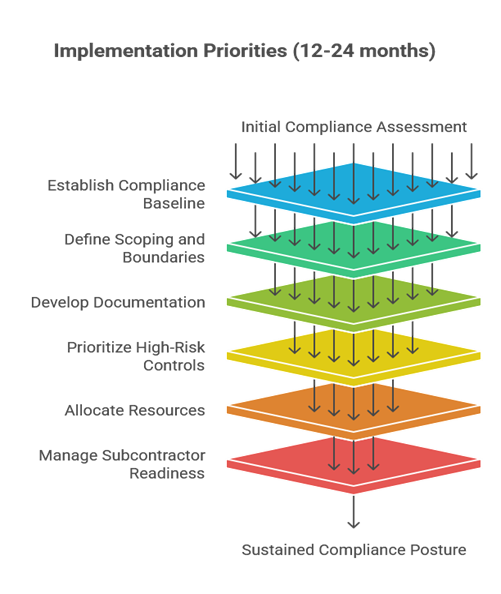
Figure: Effective remediation aligns governance decisions, scope discipline, and resource allocation rather than focusing solely on technical fixes
Remediation timelines are constrained by acquisition events rather than internal milestones. In some cases, withdrawal from specific opportunities may represent a more responsible decision than accelerated remediation under unrealistic timelines.
Successful remediation requires executive sponsorship. Authority, incentives, and accountability must align. Communication mechanisms must emphasize verification readiness rather than progress reporting alone. Deferred tradeoffs must be resolved rather than postponed.
CMMC 2.0 does not penalize organizations for discovering gaps. It penalizes organizations that fail to resolve them decisively. Remediation that treats symptoms without addressing governance rarely changes outcomes.
Under CMMC 2.0, effective remediation reflects disciplined decision making, not reactive correction.