
Article 5: Why CMMC 2.0 Failures Are Usually Organizational, Not Technical
Series: Understanding the Business Impact of CMMC 2.0 (2025–2026)
This article is part of a multi part commentary series examining how Cybersecurity Maturity Model Certification (CMMC) 2.0 reshapes assessment behavior and enforcement outcomes within the defense industrial base. The series is derived from a broader analytical paper addressing eligibility, accountability, and verification under CMMC.
When organizations fail to achieve CMMC 2.0 certification, the immediate explanation is often framed as technical. Missing controls, incomplete documentation, or configuration gaps are cited as the cause. While such issues may appear during assessment, they are rarely the underlying reason certification is not achieved. More often, failure reflects organizational misalignment. CMMC 2.0 exposes weaknesses in how responsibility is distributed, how decisions are mediated, and how priorities are enforced across the enterprise. Technical controls do not operate independently. They depend on governance structures, authority alignment, and consistent execution across functions. When those elements are misaligned, even well-designed implementations struggle under verification. Fragmented ownership is a common failure mode. Cybersecurity initiatives are often delegated to IT or security teams without corresponding authority to influence business processes. Policies may be authored without operational input. Procedures may be documented without commitment from those expected to follow them. During assessment, this fragmentation appears as inconsistency between written intent and observed practice. Misaligned incentives compound the problem. Program teams prioritize delivery schedules and cost containment, while compliance functions emphasize documentation and control rigor. Without executive mediation, informal workarounds emerge. Practices evolve to meet immediate demands, while documentation becomes aspirational rather than descriptive. Careful readers may recognize the figure below from the preceding article. Its reuse is intentional. Previously, the figure illustrated how assessments evaluate evidence across technical and non-technical domains. Here, the same components explain why failures are often organizational rather than technical. Misalignment across governance, workforce, documentation, and execution produces findings even when individual controls appear sound.
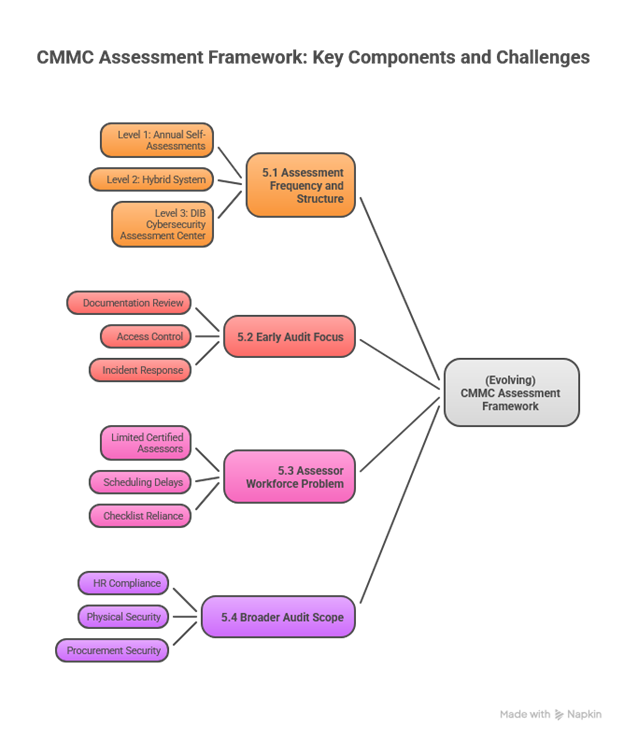
Figure: Organizational alignment across governance, evidence, and execution is as critical as technical control implementation under CMMC 2.0.
Resource planning introduces another failure point. Many organizations underestimate the effort required to sustain compliance once implementation is complete. Staffing models assume compliance is episodic. When personnel rotate or depart, institutional knowledge erodes and controls degrade quietly. Communication failures amplify these risks. Leadership may assume readiness based on progress reporting rather than verification. Teams may report milestones without validating operational consistency. When discrepancies surface, timelines are compressed and remediation options are limited. Organizations that succeed under CMMC 2.0 address alignment deliberately. They establish clear ownership, enforce cross functional coordination, and integrate compliance into routine operations. Governance resolves tradeoffs rather than defers them. CMMC 2.0 does not demand perfection. It demands consistency. Achieving that consistency is less a matter of technology than organizational coherence.