
Article 3: CMMC 2.0 Did Not Simplify Compliance.
It Clarified Accountability.
Series: Understanding the Business Impact of CMMC 2.0 (2025–2026)
CMMC 2.0 is often perceived as a simplification of cybersecurity compliance due to structural changes introduced in the revised model. While the number of certification levels was reduced and limited self-assessments were reintroduced, the practical effect was not simplification. It was clarification of accountability.
Under earlier compliance regimes, responsibility for cybersecurity outcomes was frequently diffuse. Assertions of alignment could coexist with unresolved gaps and deferred remediation. CMMC 2.0 replaces that ambiguity with explicit responsibility by tying certification outcomes to defined scope, documented evidence, and formal affirmations.
Executive accountability is central to this shift. Affirmations now represent explicit representations regarding organizational practices. When those representations are not supported by evidence, exposure becomes legal, contractual, and reputational. Cybersecurity therefore functions as a governance issue rather than a purely technical concern.
Careful readers may recognize the figure below from an earlier article in this series. Its reuse is intentional. Previously, it illustrated how CMMC 2.0 transforms cybersecurity into a condition of contract eligibility. Here, it highlights how the same enforcement architecture concentrates accountability by linking scope definition, verifiable evidence, and executive affirmation into a single governance chain.
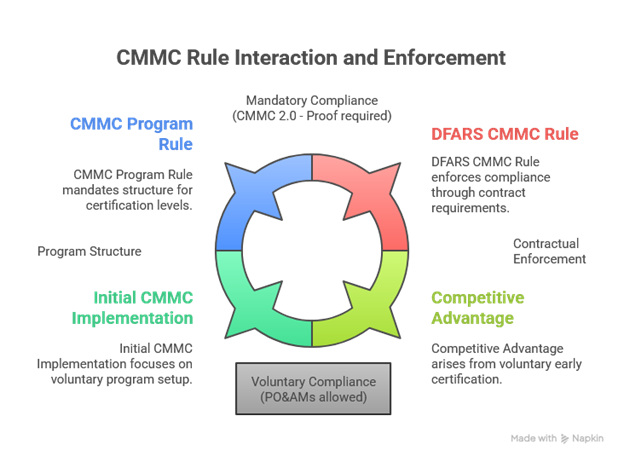
Figure: CMMC 2.0 concentrates accountability by aligning assessment scope, evidence, and executive affirmation with enforceable contract requirements.
Clarified accountability reshapes internal decision-making and extends beyond executive leadership. Middle management, compliance teams, and program leadership share responsibility for assessment outcomes. Accountability also extends into the supply chain, where subcontractor certification status can introduce cascading risk for prime contractors.
CMMC 2.0 does not reduce responsibility. It concentrates it. Accountability that was once distributed is now explicit, documented, and enforceable. Said another way (e.g., from an auditor’s perspective): CMMC 2.0 provides the lens through which an organization’s compliance is clearly defined, measurable, accountable, and absent items are more starkly realized.