
Article 2: Why “We Will Be Ready Soon” POA&Ms Are No Longer a Viable Strategy Under CMMC 2.0
Series: Understanding the Business Impact of CMMC 2.0 (2025–2026)
For many organizations within the defense industrial base, cybersecurity readiness has historically been treated as a moving target. Under prior compliance regimes, acknowledged gaps could be documented through Plans of Action and Milestones (POA&Ms) while contract performance continued. This approach created flexibility, but it also allowed risk to persist without immediate consequence.
Cybersecurity Maturity Model Certification (CMMC) 2.0 changes that model. Organizations that treat CMMC as a business qualification requirement integrate certification into planning, budgeting, and governance. Organizations that treat it as a deferred technical task increase bid risk. In a contracting environment where eligibility is binary, that distinction has measurable consequences. Certification is now evaluated at defined points throughout the acquisition lifecycle. Readiness is no longer a future aspiration. It is a condition that must be met when certification is required. Organizations that rely on the assumption that they will be `ready soon’ misunderstand both the structure and the intent of CMMC enforcement.
Two structural realities make continued reliance on POA&Ms especially risky.
CMMC assessments routinely take longer than organizations anticipate. Even contractors with experience implementing NIST SP 800-171 often underestimate the effort required to define assessment scope, assemble defensible evidence, reconcile documentation gaps, and coordinate across business functions. Dependencies spanning IT, human resources, procurement, legal oversight, facilities, and executive governance introduce friction that cannot be resolved quickly.
Assessment capacity further compounds this challenge. The CMMC Third-Party Assessment Organization (C3PAO) ecosystem remains capacity-constrained relative to anticipated demand. Organizations that delay readiness while relying on POA&Ms may find themselves unable to schedule an assessment in time to support a bid or contract modification. In that context, partial implementation and documented intent provide no practical value if certification cannot be demonstrated when required. Said another way, the C3PAO backlog is an entirely foreseeable reality and therefore is not seen as a valid reason for failing to gain certification.
These constraints create a timing problem rather than a capability problem.
CMMC 2.0 reshapes competition by rewarding organizations that achieve certification early. Therefore, certified contractors gain access to opportunities that are unavailable to others, regardless of relative technical merit or past performance. Late adopters face compressed timelines, reactive remediation efforts, and the possibility of exclusion simply because readiness did not align with enforcement schedules.
This timing dynamic also alters internal decision-making. Treating POA&Ms as an acceptable bridging strategy often leads to underfunded initiatives and fragmented ownership. When certification requirements appear in solicitations or contract modifications, unprepared organizations are forced into reactive postures that increase cost and risk. Organizations that integrate readiness into planning cycles and pipeline forecasting respond deliberately rather than urgently.
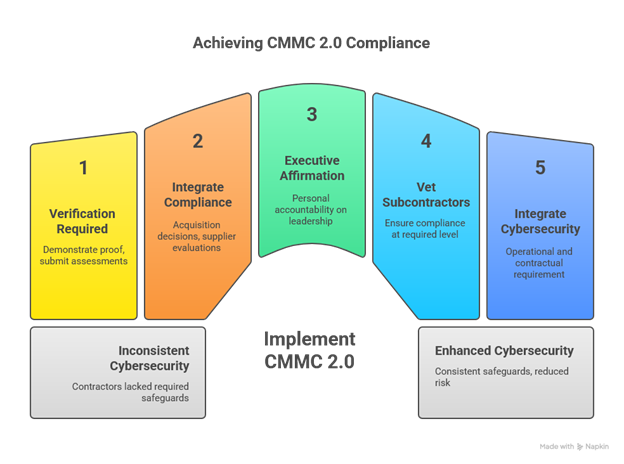
Figure: CMMC readiness progresses through defined stages that require sustained coordination and evidence development, not deferred remediation.
The verification-based nature of CMMC makes “near” readiness operationally indistinguishable from non-compliance. Assessments evaluate observable practices and documented evidence. They do not reward intent or future plans. In this environment, POA&Ms that extend beyond allowable limits cease to function as risk-management tools and instead become sources of disqualification.
CMMC 2.0 forces a recalibration of how organizations think about time and risk. Readiness must align with acquisition realities rather than internal optimism. Certification timelines function as business constraints, not aspirational milestones.